Observe
A projection brings a plant, a page and a difficulty into view: reading a name does not always tell us what it refers to.
Reference experience · Córdoba, 10th century
A book has travelled. Its words still raise questions. Understanding them takes what other people know.
One case illustrates how the museum would turn a documented history into participation and learning for its audiences. The proposal brings together narrative, interaction and operational criteria.
01 / The story behind the experience
In 10th-century Córdoba, an Arabic translation of Dioscorides’ treatise from Baghdad was already circulating. Some plant names remained difficult to understand. Ibn Juljul’s account, preserved by Ibn Abi Usaybi’a, describes physicians in Córdoba, including Muhammad al-Shajjar, working with the Jewish physician Hasday ibn Shaprut and the monk Nicholas to clarify them.
This case lets us explore how different kinds of knowledge contribute to a shared question. It took place in a courtly setting shaped by hierarchy and inequality; it does not describe all of Andalusi society.
Read the transmitted account and its notes ↗What changes when understanding
comes from another perspective?
02 / The visitor experience
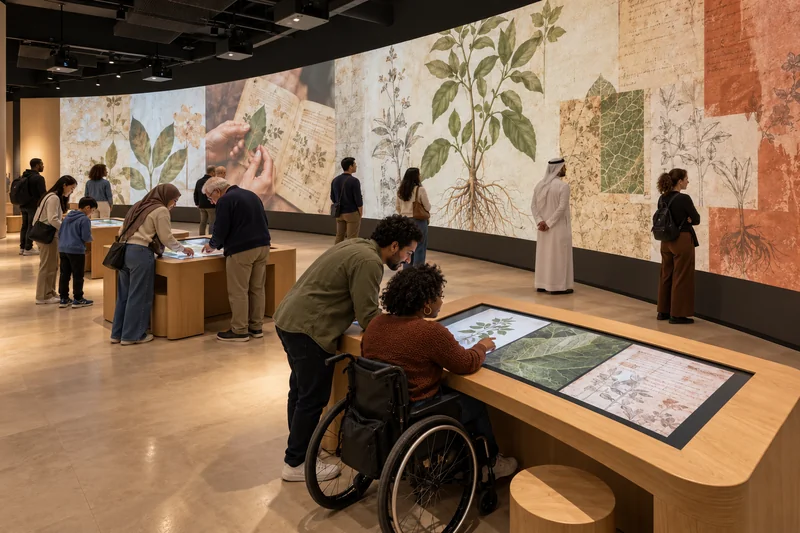
The room presents a shared question. Each visitor can explore a table, share it with someone or follow the narrative from outside. Stations operate independently.
A projection brings a plant, a page and a difficulty into view: reading a name does not always tell us what it refers to.
The table offers three layers: description, image and linguistic context. Each contributes something the others do not show.
The response explains what each source adds and what remains unresolved. A brief synthesis joins the shared wall without interrupting the story.
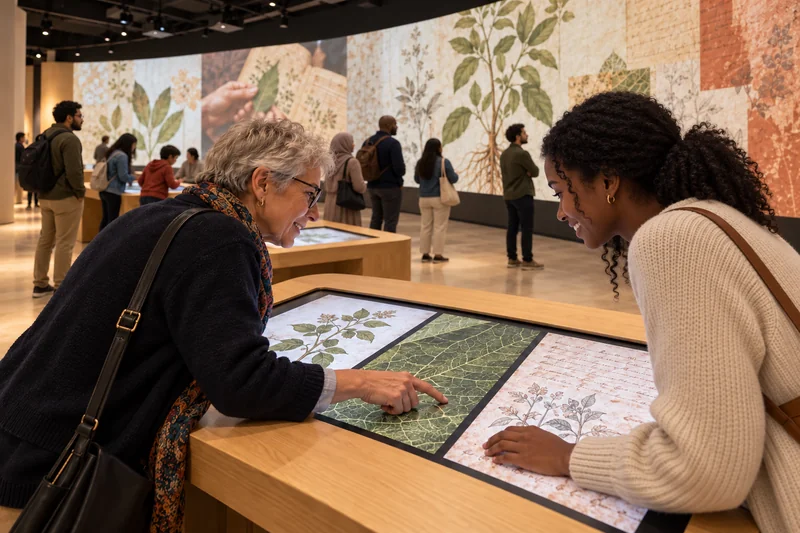
The interaction invites comparison before reaching a conclusion. There is no race to get the answer right: attention turns to what another source reveals and to the limits of each interpretation.
Species, words and documents will be selected with specialists. Drawings in these visualisations are neither facsimiles nor validated botanical identifications.
03 / A gallery that keeps moving
Tables have independent starting points. A visitor can explore without waiting for the whole room to finish.
The audiovisual story makes sense on its own. Participation adds depth; observation is part of the visit too.
Reading and listening, legible contrast, reachable controls and space for a seated approach. These conditions will be tested in the prototype.
Contributions appear in short turns and separate wall zones. One interaction does not replace everyone else’s work.
Station numbers, interaction times and capacity remain subject to visitor testing and venue studies.
04 / From source to interpretation
The circulation of an earlier Arabic translation and the episode of research in Córdoba. The sources explain how the account was transmitted and its limits.
The gallery, comparison layers and collective response are contemporary interpretive choices. They do not reconstruct a known historical session.
The choice of plants, terms, translations and images; the script and its omissions. Historical, linguistic and botanical review is needed before production.
An edition of historical sources and an academic study. Their mention does not imply collaboration with the museum.
05 / A concrete first step
We propose developing a first documented case, an audiovisual script and a working station with an institution. Visitor testing will help us observe what people understand, how they participate and where waiting occurs.
The result: a revised concept, evidence from visits and an estimate of the resources required to expand it. Team, rights, funding and timetable will be agreed before work begins.
Develop this experienceExplore the other experiences